Annapurna Bhandar Application: If you live in West Bengal and are looking to benefit from the Annapurna Bhandar scheme, understanding the exact documents required for the application is the first and most important step. Many applicants face rejection not because they are ineligible, but simply because they submit incomplete or unclear paperwork. This guide walks you through every document you need, why it is required, how to prepare it correctly, and what mistakes to avoid — so your application gets approved without any unnecessary delays.
What Is the Annapurna Bhandar Scheme?
Before diving into the document list, it helps to understand what this scheme is all about. Annapurna Bhandar is a West Bengal state government initiative designed to provide subsidised or free essential food items and daily necessities to economically weaker sections of society. The scheme operates through a network of outlets spread across the state, and eligible beneficiaries can collect commodities at highly subsidised rates.
To access these benefits, citizens must register themselves by submitting an application form along with a set of supporting documents. Since the scheme is linked to Direct Benefit Transfer (DBT), accurate documentation is critical — not just for eligibility verification, but also for ensuring that any financial benefits reach the right bank account without any processing errors.
Why Document Verification Matters in This Scheme
The Annapurna Bhandar scheme is funded by the state exchequer, and the government takes strict measures to ensure that only genuine and eligible residents receive its benefits. Authorities cross-verify your documents against state and central government databases. A mismatch in your name, address, or bank details between two documents can lead to automatic rejection.
Moreover, since Aadhaar-based DBT is involved, all your submitted records must be consistent with your Aadhaar information. This is why submitting fresh, clear, and matching documents matters so much.
Complete List of Documents Required for Annapurna Bhandar Application
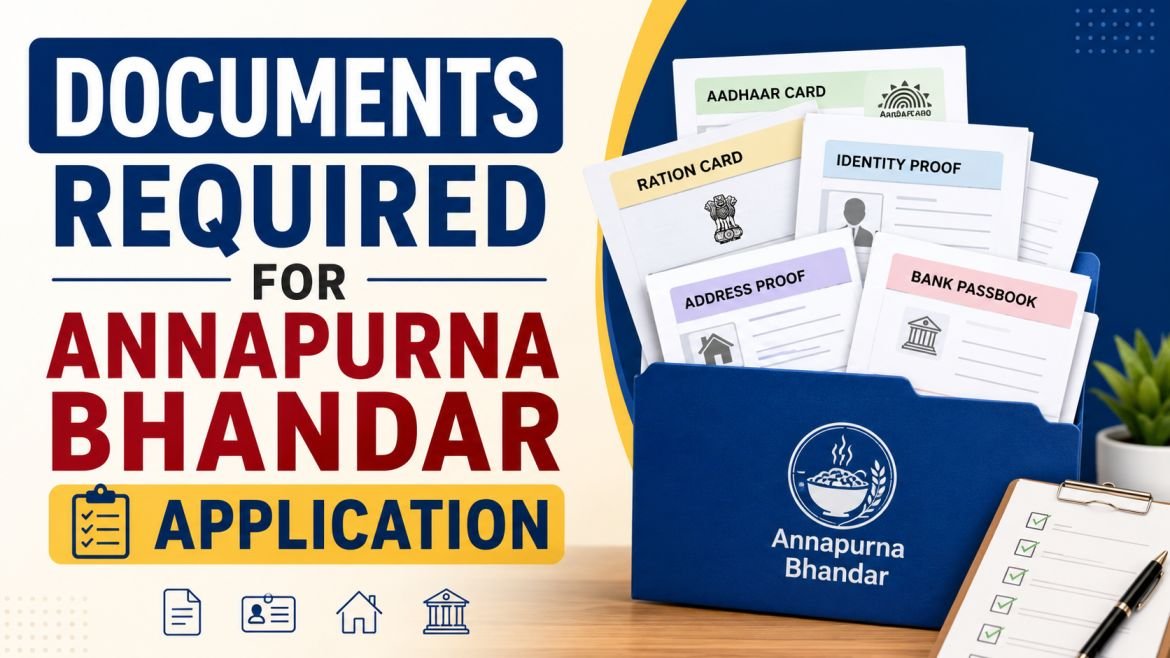
Here is a detailed look at each document you need to prepare before submitting your application.
1. Aadhaar Card
Your Aadhaar card is the foundational document for this application. It serves a dual purpose — it establishes your identity and it enables DBT linking, which means any cash benefit or subsidy gets transferred directly to your linked bank account without going through any middleman.
Make sure the Aadhaar card you submit is active and up to date. If your address or name has changed recently, update your Aadhaar details before applying. A photocopy that is blurred, expired, or shows inconsistent information compared to your other documents will almost certainly result in rejection.
Pro tip: Download an e-Aadhaar from the UIDAI website and use that as your copy. It is equally valid and much cleaner than a worn-out physical card.
2. Voter ID Card or Ration Card (West Bengal Residency Proof)
One of the eligibility criteria for Annapurna Bhandar is that you must be a resident of West Bengal. To prove this, you are required to submit either your Voter ID Card or your existing Ration Card.
Your Voter ID Card (also called the Electoral Photo Identity Card or EPIC) must show a West Bengal address. If you have recently relocated from another state and your Voter ID still shows an old address, it may not be accepted as valid residency proof.
Alternatively, a Ration Card issued by the West Bengal government clearly establishes your residential status. If you do not have either of these, you may want to consult your local block or municipality office to check if any other residency proof is acceptable, though these two are the primary options specified in the scheme guidelines.
3. Bank Passbook (First Page) or Cancelled Cheque
Since this scheme is linked to Direct Benefit Transfer, authorities need to verify your bank account details to ensure that subsidies or payments can be processed correctly. You must submit either the first page of your bank passbook or a cancelled cheque from your active savings account.
The first page of your passbook should clearly show your full name, account number, IFSC code, and branch address. These details must exactly match your Aadhaar-linked bank account. If you have multiple bank accounts, submit the one that is linked to your Aadhaar for seamless DBT processing.
If you are submitting a cancelled cheque, cross it lightly with two parallel lines and write “Cancelled” across it. Never submit a blank cheque without cancelling it first.
4. Caste Certificate (If Applicable)
If you belong to a Scheduled Caste (SC), Scheduled Tribe (ST), or Other Backward Class (OBC) category, you may be eligible for additional reserved category benefits under the scheme. To avail of these, you need to submit a valid Caste Certificate issued by a competent authority in West Bengal, such as a Sub-Divisional Officer or Block Development Officer.
Make sure the certificate is not expired. Many caste certificates come with a validity period, and submitting an outdated one could disqualify your application from the reserved category benefits, even if you are genuinely eligible.
If you are a general category applicant, this document is not mandatory and you can skip it.
5. Income Certificate
Depending on the specific provisions and the income ceiling applicable at the time of your application, you may be required to submit an Income Certificate. This document, issued by a gazetted government officer or a revenue authority, confirms that your household income falls within the prescribed limit to qualify for subsidised benefits.
Income certificates are typically issued by the Sub-Divisional Officer’s office or the Block Development Office in rural areas. You can also get one from your municipality if you reside in an urban area. Make sure the certificate is recent — ideally not older than six months — as authorities may reject outdated income proof.
If the scheme guidelines at your area’s local office specify that no income ceiling applies to your category, this document may not be compulsory. Always confirm with the issuing authority before skipping it.
6. Passport-Size Photograph
You need to attach a recent colour passport-size photograph to your application form. This photograph is used for identification purposes and becomes part of your beneficiary record in the scheme’s database.
The photograph should be taken against a plain white or light-coloured background. It must be recent — avoid using old photographs that no longer resemble your current appearance. A blurred or low-quality photograph is a surprisingly common reason for application rejection at the initial screening stage.
Carry at least four to six copies of the photograph when you go to submit the form, since you never know if additional copies might be needed.
7. Active Mobile Number (for OTP Verification and Payment Alerts)
While not a physical document in the traditional sense, your active mobile number is a mandatory requirement for the application process. It is used for OTP (One-Time Password) verification during registration and for receiving payment alerts and scheme-related notifications.
The mobile number you provide should ideally be linked to your Aadhaar. If your current number is not linked to Aadhaar, you can do so at any Aadhaar enrolment centre or Common Service Centre (CSC). An Aadhaar-linked mobile number makes the DBT process smoother and reduces the chances of verification failures.
Make sure the number you register is active and accessible to you at all times. Do not use someone else’s number for registration.
Conclusion
Applying for the Annapurna Bhandar scheme does not have to be stressful or confusing. If you gather all the documents listed in this guide, prepare clear and self-attested photocopies, and ensure your name and bank details are consistent across all records, your application has a strong chance of being approved smoothly.